
Desk Job Damage: How to Protect Your Back, Joints and Energy After 40
-
By Dijin KP
By four in the afternoon, the body starts filing its complaints. A tight lower back, a stiff neck, hips that creak when you stand up, and a tiredness that has little to do with how much work you actually got through. In your twenties, you could ignore all of it. After 40, it gets harder to talk yourself out of.
This is the reassuring part. Desk work doesn’t wear you out. Calm that lasts for a long time wears it down, and stillness is something you can shatter. You may protect your back, keep your joints active, and replenish some of the energy you lost in the afternoon by doing minor routines every day.
To put it briefly, moving more than you sit, strengthening your muscles twice a week, and changing positions frequently are the greatest ways to prevent desk work strain after the age of forty. On its own, a chair, cushion, or gadget is insufficient.
This guide walks through what a desk day does to your body and what you can do about it, one habit at a time.
What a desk job does to your body after 40
Nothing dramatic happens on your fortieth birthday. The change is gradual. Muscle mass slowly declines when it isn’t challenged, recovery takes a little longer, and the tissues around your spine and joints become less forgiving of being held in one position for hours.
Sitting makes that worse. Your shoulders move forward in the direction of the screen, your hip muscles shorten, and your glutes shut off. As a result, the lower back performs tasks that stronger, more active muscles ought to share. By mid-afternoon, circulation also slows, which contributes to the feeling of being dizzy and heavy.
The aches you notice in the evening are often the bill for a day of not moving. The good news is that the bill can be paid in small instalments.
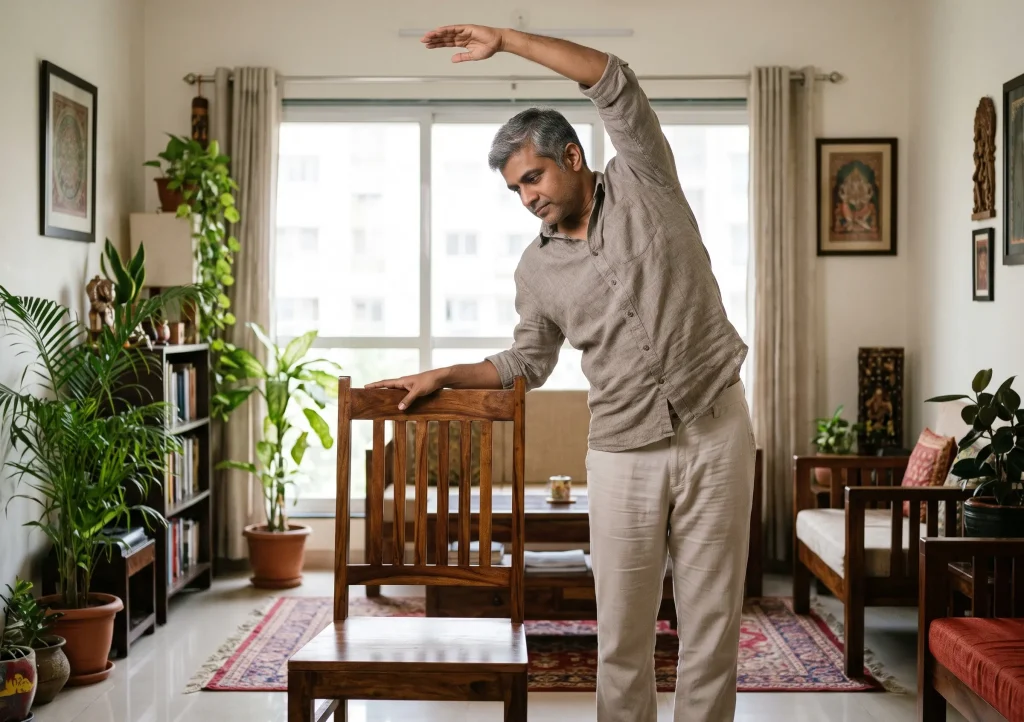
Protecting your back: variety beats the “perfect” posture.
Most of us were taught that there is one correct way to sit. Physiotherapy guidance says otherwise: no single sitting position is best, and the real trouble comes from staying in any one position for too long. Back pain at a desk also doesn’t automatically mean you are damaging your spine. More often it is a signal that it’s time to change what you’re doing.
A few things that will genuinely help:
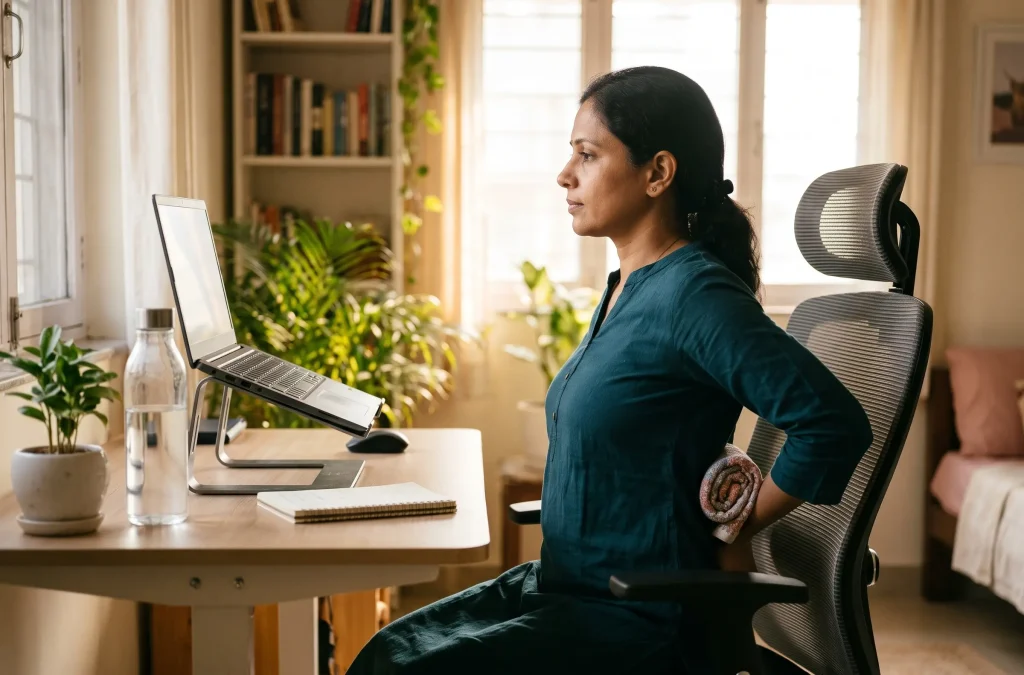
- First, set up the basics. Place the screen at eye level, place a small cushion or rolled towel in the curve of your lower back, and place your feet flat on the floor (use a footrest if they can’t reach).
- Change positions frequently. Lean back, change your weight, alternate between sitting and standing, or go for a quick stroll. A reasonable rhythm is once per hour or so.
- Take small breaks. Stretching your arms and averting your gaze from the computer for even ten to fifteen seconds relieves tense muscles.
- But don’t make it a long break. When your back flares up, moving gently is usually more beneficial than being in bed for days.
A standing desk is useful, but only if you actually alternate. Long static standing is no kinder to your body than long sitting.
Looking after your joints: hips, knees, shoulders and wrists.
Joints like movement. It circulates fluid through them and keeps the muscles around them working, and a desk gives them very little of either.
Bending at a ninety-degree angle for hours causes problems for the knees and hips. You’ll get more out of standing up, walking to refill your water bottle, and performing a few gentle squats or hip stretches. In order to avoid pushing your chin forward, roll your shoulders back, expand your chest against a wall or doorframe, and raise your monitor. Your neck and shoulders are responsible for the forward lean. Keep your elbows close to your sides and shake your wrists and forearms between jobs because using a keyboard and mouse wears them out.
Why strength is your best long-term protection
If you take only one idea from this article, take this one. Strong muscles hold your body in better alignment and are less likely to get strained. Core strength won’t cure desk-related back pain on its own, but it makes you more tolerant of the awkward positions every working day throws at you.
The US Physical Activity Guidelines recommend 150 to 300 minutes of moderate activity each week, plus muscle-strengthening work on at least two days. You don’t need a gym for the second part. Squats to a chair, wall or knee push-ups, glute bridges, planks, resistance-band rows and carrying something heavy for a short walk all count.
Aim for the muscles a desk takes away: the glutes, hamstrings, core and upper back. Two sessions of 20 to 30 minutes is a fair start. Begin lighter than you think you need to, and add effort slowly, especially if you haven’t trained in years.
Fixing the midday energy drop
Being exhausted when working at a desk is not a sign of laziness. Extended periods of inactivity impede circulation, and a body that is not frequently pushed develops fatigue. Here are some tips which are helpful:
• Move before you crash. A five-minute walk is typically more energising than another cup of coffee or tea.
• Drink water through the day. Mild dehydration shows up as tiredness and headaches.
• Eat a proper lunch with some protein, so you aren’t running on biscuits by three o’clock.
• Get daylight. Step outside, even for a little while, and your body clock will thank you.
• Protect your sleep. Muscles and joints repair overnight, and no stretch routine makes up for six restless hours.
Small habits worth dropping
Certain desk behaviours, including working from a laptop on your lap, eating lunch at your desk, sitting with your legs crossed for hours, cradling the phone between your ear and shoulder, and perching on the chair’s edge, subtly increase stress. By itself, none of these are disastrous. The problem is that they do this for years, eight hours a day, five days a week.

A realistic routine for a busy week
A total change in lifestyle is not necessary for any of this. This version accommodates deadlines and meetings:
• Every hour: stand up, stretch, change position, and look at something far away.
• At lunch: a 10 minute walk after lunch, ideally outdoors.
• Twice a week: 20 to 30 minutes of strength workout at home or in a gym.
• Most evenings: a short walk to loosen your hips and clear your head.
If a plan looks too difficult, shrink it. A habit you keep beats a perfect one you drop in week two.
Signs it’s time to see a doctor
Most desk-related discomforts improve with movement. However, get checked out if you have numbness, tingling, or weakness in a leg or foot, discomfort after a fall or accident, pain that wakes you up at nite or keeps getting worse, or any ache that hasn’t gone away after a few weeks. A blood test is particularly helpful if you have these symptoms together with persistent fatigue, as low levels of vitamin B12 or vitamin D may be a contributing factor.
Back to that four o’clock feeling
Your body is requesting something basic, such as a shift in posture, some strength training, or a small walk, when you have back pain and afternoon fatigue. You don’t have to reconstruct your life or quit your work. Tomorrow, make it a habit to stand up every hour. Next week, add another modest habit. In a few months, four o’clock may begin to feel much more like midday.