
Sarcopenia or Muscle Loss While Aging: Why It Happens and How to Slow It Down
-
By Nandikesam

The gradual loss of muscular mass, strength, and physical function that starts about age 30 and accelerates around age 60 is referred to medically as sarcopenia. The pace is not set, although it is a typical aspect of growing older. Frequent strength exercise, adequate nutrition, and an active daily schedule can halt the process and, in many cases, restore strength you previously believed to be lost.
That last part matters, because most people treat weakness in later life as a fact of birthdays. It is closer to a habit problem than a destiny problem. Here is what is actually happening inside your body, how to spot it early, and what you can do about it starting this week.
What Is Age-Related Muscle Loss?
Sarcopenia comes from two Greek words meaning “flesh” and “loss.” It describes a combined drop in muscle size, muscle strength, and the ability to do everyday physical tasks.
Research suggests adults lose roughly 3 to 8 percent of their muscle mass per decade after 30, and the rate climbs after 60. Strength usually falls even faster than size. A person can look much the same on the scale and still be noticeably weaker than they were ten years ago, because the quality of the remaining muscle declines as well. Fat slowly settles into muscle tissue, and the nerves that switch muscle fibres on become less efficient.
This is why weight alone is a poor way to track your health. Two people of the same age and weight can have very different amounts of muscle, and the one with more usually has the easier time with stairs, falls, and recovery from illness.
Why Muscles Shrink as We Get Older
There is no single cause. Several changes pile up together, and some of them are within your control.
Less movement. This is the biggest and most fixable factor. Muscles follow a simple rule: use them or lose them. Long hours of sitting, fewer physical jobs, and reduced activity after retirement all tell the body that it can afford to let muscle go.
Anabolic resistance. Younger muscles respond strongly to protein and exercise by building new tissue. With age, that response weakens. The same meal or the same workout produces a smaller reaction, so older adults need a bit more of both to get the same result.
Hormonal shifts. Levels of testosterone, oestrogen, growth hormone and IGF-1 all decline with age. These hormones help maintain muscle, so when they fall, the balance between building and breaking down tissue tilts the wrong way. Menopause in particular is linked with a faster loss of muscle and bone.
Nerve changes. Muscles are only as good as the signals they receive. Over time, some of the motor neurons that control muscle fibres die off. The fibres they served can be rescued by neighbouring nerves, but not always, and fast-twitch fibres, the ones responsible for power and quick reactions, are hit hardest.
Low-grade inflammation. Ageing tends to bring a constant, mild inflammatory state. Chronic conditions such as diabetes, heart disease and kidney problems add to it and speed up muscle breakdown.
Poor nutrition. Appetite often drops with age. Meals get smaller, protein gets skipped, and the diet slowly runs short of what muscle needs to repair itself.

Early Signs of Muscle Loss
Sarcopenia rarely announces itself. It shows up as small inconveniences that are easy to explain away. Watch for these:
• Walking more slowly than you used to, or feeling tired on once-easy routes
• Needing your hands to push up from a chair or the toilet
• Weaker grip, such as struggling to open jars or carry shopping bags
• Trouble climbing stairs without holding the rail
• Clothes loosening around the arms and thighs even though your weight is steady
• Dropping things more often or losing balance on uneven ground
• Unplanned weight lossYou may get a general idea by doing two easy house checks. Check to see if your walking pace has decreased over the previous year by timing how long it takes you to get up from a chair five times without using your hands. A noticeable change is worth reporting to a physician, but neither is a diagnosis
Why It Matters Beyond Appearance
Muscle is not just for movement. It acts as a reserve for the whole body. It helps regulate blood sugar, supports bone density, keeps metabolism steady, and provides the protein your body draws on during illness or surgery.
The consequences spread when muscle declines. Falls are more common, and the healing time for fractures sustained in falls is longer. Because carrying groceries, getting out of a car, or rising a few stairs begins to feel like work, independence decreases. Low muscle strength has also been linked in studies to an increased risk of type 2 diabetes, longer hospital admissions, and early mortality. The encouraging side of the same coin is that building muscle in later life brings benefits that reach well beyond the muscle itself.
How to Slow Muscle Loss: What Actually Works
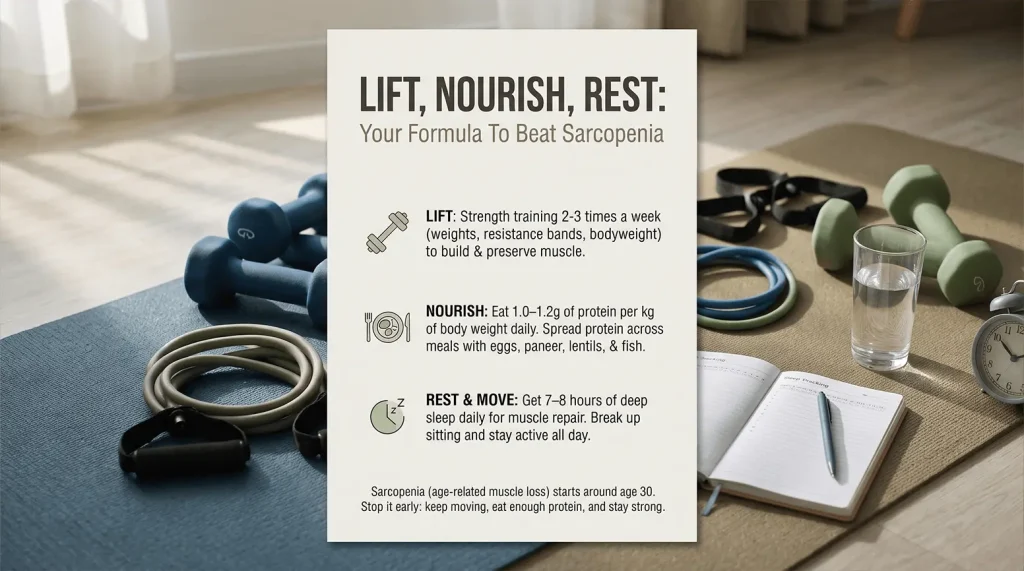
1. Lift something heavy, twice or three times a week
The best method for preventing sarcopenia is resistance training. Even in their 80s and 90s, muscles continue to perform well when challenged. After a few months of lifting, studies on nursing home residents in their 90s have demonstrated strength gains.
A gym membership is not a necessity. You can use your own body weight, dumbbells, resistance bands, or two full water bottles. Focus on movements that use big muscle groups:
• Squats or sit-to-stand from a chair
• Push-ups against a wall or counter
• Rows with a band or a light weight
• Glute bridges
• Step-ups on a low step
• Carrying a heavy bag for distance
Increase the difficulty gradually. If you are new to exercise or have a medical condition, a session with a physiotherapist or a qualified trainer is a good investment.

2. Eat enough protein, and spread it through the day
Older adults usually need more protein than younger ones to maintain muscle. Many expert groups suggest roughly 1.0 to 1.2 grams per kilogram of body weight each day for healthy older adults, and somewhat more for those who exercise regularly or are recovering from illness. For a 65 kg person, that is about 65 to 80 grams daily.
The way you divide it also matters. Moderate portions at each meal are more beneficial to muscles than a single huge portion at evening. For breakfast, lunch, and dinner, aim for about 20 to 30 grams.
Eggs, curd, paneer, milk, fish, poultry, lentils, chickpeas, soy, tofu, nuts, and seeds are all excellent sources. With dal, curd, an egg, or a piece of fish or paneer at the appropriate meals, a classic Indian plate can easily reach the aim. Consult your doctor before increasing your protein consumption if you have kidney illness.
3. Move all day, not just during workouts
Ten hours in a chair cannot be completely offset by one hour of exercise. Break up extended periods of sitting, take a walk after eating, utilise the stairs when it’s safe to do so, and spend time on your feet doing gardening or housework. Walking promotes circulation, balance, and the everyday exercise that prevents muscles from fading, but it won’t create much muscle on its own.
4. Protect your sleep and your vitamin D
Muscle repair happens largely during deep sleep, and poor sleep raises stress hormones that break tissue down. Seven to eight hours is a reasonable target for most adults.
Vitamin D deficiency is common, even in sunny countries, and low levels are associated with weaker muscles and a higher fall risk. Get your level tested before taking supplements, and follow your doctor’s advice on dosing.
5. Be careful with crash diets
Cutting calories sharply, especially without enough protein or resistance exercise, strips away muscle along with fat. If you want to lose weight in midlife or later, go slowly, keep protein high, and keep lifting. The goal is to lose fat, not strength.
6. Ask about supplements, but treat them as extras
Some people benefit from creatine, whey protein, or omega-3 fatty acids, and there is reasonable evidence for creatine combined with strength training in older adults. None of these replace food and exercise, and each should be discussed with a doctor, especially if you take regular medication.
When to See a Doctor
Book an appointment if you notice a sudden drop in strength, unexplained weight loss, repeated falls, or difficulty with everyday tasks. Muscle loss can be linked to thyroid problems, hormonal changes, nutrient deficiencies, and chronic illness, all of which can be treated once identified. A doctor can also check your grip strength, walking speed, and body composition, and refer you to a physiotherapist or dietitian if needed.
The Bottom Line
Aging changes your body, but it does not take away your ability to respond to effort. Muscle loss while aging is gradual, which also means it can be caught early and managed. The people who stay strong into their later years are rarely the ones with special genes. They are the ones who keep lifting, keep eating enough protein, keep moving, and keep showing up.
Begin small. Start by picking two strength exercises you can do at home, add a protein source to your breakfast, and take a ten-minute walk after dinner. Do that for a month, then build from there. Your future self, the one climbing stairs without thinking twice, will be glad you began today.